


I’m not a fan of famous quotes, but I am precious about the little non-sequiturs that come to me in passing. For example, I remember repeatedly thinking of the phrase “uninterrupted space” while in a sensory deprivation chamber back in Columbus several years ago, and then finding more meaning in it when I found it in an Anthony Bourdain book where he used it describe an empty nightclub. In the spirit of finding meaning where there was once none, and where there still may not be any meaning to anyone else, this entire post was written on top of an old note that I had saved in March of 2025 and the only words were “Profundity is in the eye of the beholder.” The way I see it, this larger essay is scribbled in the margins of that original note.
Remy is eleven weeks old as of yesterday1, which is not “almost three months” if Elizabeth asks. Thanks to TikTok, Elizabeth is acutely aware of developmental milestones. The algorithm knows our daughter’s age, thanks in part to the nine months of pregnancy content Elizabeth watched preceding Remy’s birth. Elizabeth has gone back and forth in how she thinks about all this content, which is so successful because of the strong emotions that it creates. Everyone knows that rage on the internet drives strong reactions, and that’s why news feeds from the New York Times to Reddit all have such click-bait and emotionally coded language. Rage drives attention and keeps eyeballs engaged, which is what is truly important for the internet’s main customer: advertisers. But the pregnancy and “fourth trimester” content that Elizabeth is served is aimed at driving sentimentality, which isn’t exactly the same as rage, but it still helps sell artipoppe brand baby carriers.
There are many variations on these kinds of videos targeted at young parents, mostly to young mothers. Imagine a woman 38 weeks pregnant holding her belly and then cut to 38 weeks postpartum with the same woman holding a bouncing babe. Or picture a toddler hesitantly making their way through a hall at one year old and then excitedly walking through that same frame at two years old. This is the tip of the iceberg, because there really is so much that new parents can be sentimental about. Normally, you wouldn’t even know that something your child is doing today is only going to last a few weeks, unless you had a lot of experience around children. But, thanks to the algorithm and the power of short form vertical videos, you can be made aware that that milestone is going to come and go, and you’re also gently informed that you better capture it on camera because you’ll never see it again.
This struck us the first week with newborn “chirping,” which is extremely hard to capture because it’s just a little sleep sound. You need to be filming the baby before the chirp, which you will have no warning is coming. There is plenty of b-roll of Remy, just sleeping, with Elizabeth and I silently off camera hoping to capture this chirp. We each captured one, and there is debate that either of us really got the “right” sound. Elizabeth was adamant that we record it, which to her credit was smart and timely, because the two noises we recorded were probably among the last ten total chirps before Remy outgrew that specific newborn behavior.
Similarly, people are obsessed with the “newborn scrunch”, when the baby keeps their legs and butt curled under themselves when they are picked up, a phenomenon which goes away once they’ve spent enough time away from being curled up in the womb. Elizabeth and I in particular are fans of this little gag that newborns make. It’s a smaller niche than the scrunch but we’re solidly in some market for it. TikTok knows people like us are out here. Elizabeth sent me a video of another baby making the little gagging face, which was something Remy did a lot of in her early days, and I unfortunately don’t think we have footage of it.
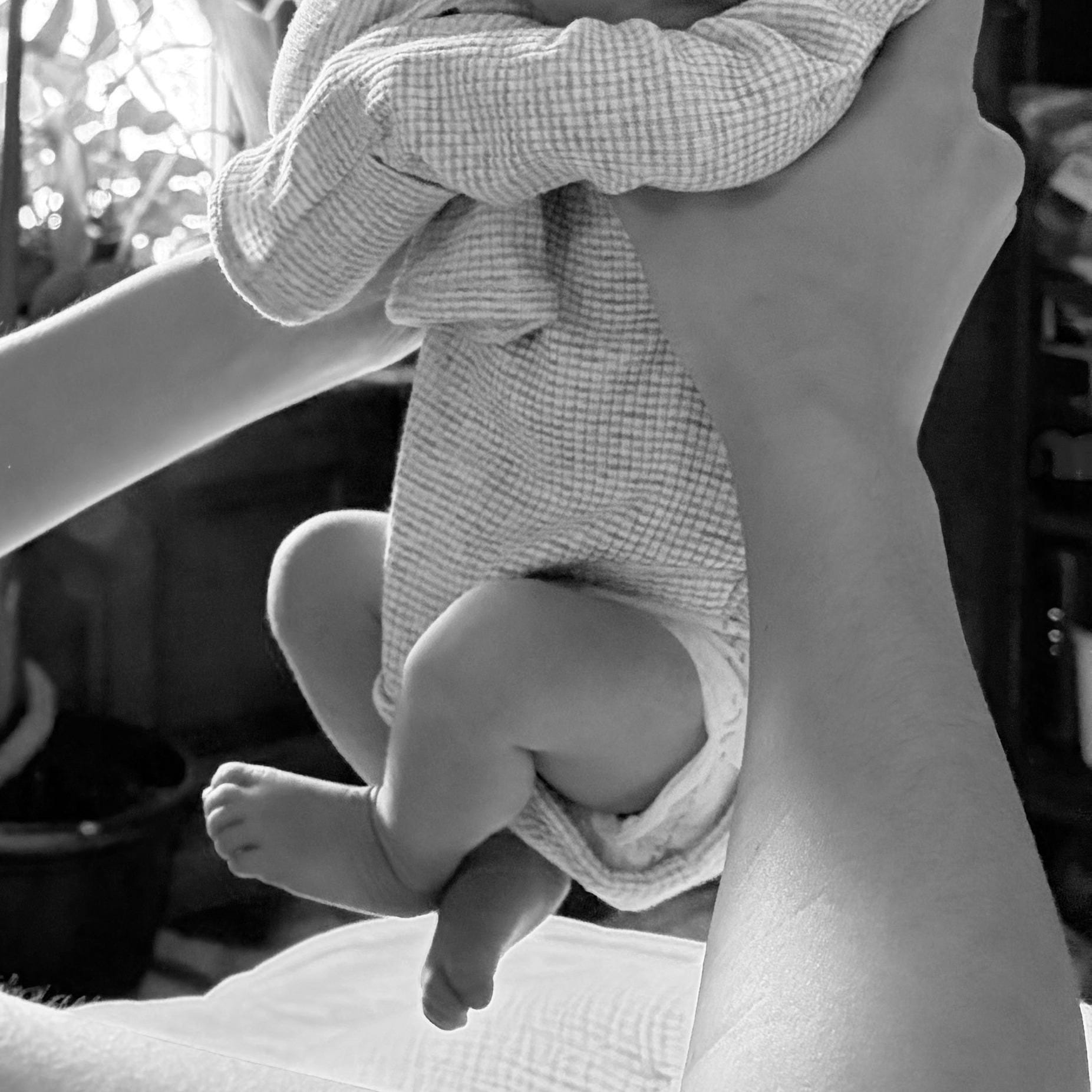
As I said, Elizabeth recognizes that this level of awareness and the stress induced by it aren’t exactly normal. Multiple times she’s stated that she refuses to be caught up in this commercially reinforced sentimentality, but she and I are both afraid of what Remy will soon stop doing. Before Remy, I wouldn’t have been able to guess at what age a child is capable or is not capable of doing something by broad strokes. Can a six-month-old talk? Can a six-year-old read? No idea. Our friend sent us a picture of their child’s first solid food, which was scrambled egg, but I assumed based on shape and color2 that it was cheese popcorn. When is the appropriate time for baby’s first cheese popcorn? I won’t know it until I see it.
This lack of awareness is one reason I feel slightly guilty about my past reactions to hearing that friends were pregnant or that they had their first child. I knew to say “congratulations”, but my social skills really dropped off after that. I didn’t know what a new parent needed or wanted to hear. Now, with our first child, I am so much more excited for friends when I hear about their upcoming new family members. This is the same for weddings. Our first wedding anniversary is today. For friends married before us, a wedding was a party where two very popular people had a free pass on PDAs. After our wedding, I recognize the weird sense of being surrounded by love and how people are there just for you. You are the center of attention but there is no pressure to perform. There is a gravity to getting married, or having children, that is hard to understand until you go through it.3 I’ve always cried at wedding ceremonies, but for the last year the waterworks have been much worse.
Usually at the same time we talk about not getting caught up in all this “parents, just you wait and see” commotion, Elizabeth and I talk about our own parent’s sentimentality about us. For me, being born was just like any other day, but it was one of the most important days in my parent’s lives. Elizabeth comments that how we look at Remy, as this little person we adore and love, was how our parents looked at us. We stare all day long. Of course, Remy is just now able to really look back at us, but we’re just “Milk Lady” and “Diaper Man.” One day, I will graduate the same way my father did, on to a new role as “Weather Man.” The sentimentality goes both ways between parent and child, but it’s different.
I hate essays that provide definitions, because I feel like it’s just trying to hit some word count, but I liked how Wikipedia defined sentimentality as “a reliance on shallow, uncomplicated emotions at the expense of reason.” That is a pretty brutal description and one that I would have openly and blindly applied to my parents for my entire life until around eleven weeks ago. The generation to which my parents belong is broadly sentimental, so it’s not some personal character flaw. I have been a big fan boy of “reason”, so I have sold things like my two of my first guitars, both at a loss just to offload stuff. No expense of reason here, but for most people, there is a logical fallacy called the “Endowment Effect” that means we assign higher value to things we already own than we would if we were looking to buy that same thing from someone else. We value it because it’s ours. You can call that “a shallow emotion at the expense of reason,” or you can recognize that the profundity is in the eye of the beholder.
Flying in the face of all my feelings about my parent’s sentimentality over old stuff, I know there is a onesie that I selfishly do not want to gift as a hand-me-down to the next expecting couple. So, knowing that several of the times that I’ve moved I’ve just left the majority of my stuff behind, and though I’ve murdered most of my darling journals, poems, and drafted essays, I will be keeping a small gray onesie with a Teddy bear stitched in the front. I think I’ll have it framed, and I hope Elizabeth makes a TikTok about it. And I hope you cry when you see it.
Elizabeth suggested that I give an update on parenting in each of my Palmer Press posts going forward, and that I call it “Remy’s Corner.” At first, I thought “This isn’t what my readers signed up for,” but then again, I don’t know how I got any of you to subscribe to this nonsense. I started this essay with Remy’s Corner, and if you can’t tell, it became all consuming.
Whatever shades of color that were accessible to me, as someone on the “color deficiency spectrum.”
Of course, no offense to my unmarried and childless readers, you understand feelings that I can’t, I’m sure.
Might be my favorite piece of yours yet. For me as well, feels like peering into my future a bit. Very well written.