


Those that have known me long enough have heard my diatribe on “Tension and Release.” The origins go back to late 2011 or 2012 when I ruined one of my high school metal-core band’s rehearsals arguing over our musical direction. Your Dying Breath was a metal-core band, and one of the core elements of the genre is that it never strays far from the root note1. I had been starting to learn a little bit of jazz harmony and was interested in how playing one chord in a certain context naturally resolves to the next. Some chords create tension, and other chords release that tension. So I derailed the practice by complaining how our continuous hammering of one note wasn’t really driving home the tension and release, at least for me. I was obviously not woke to rhythmic tension being just as viable as harmonic tension, but I still believe that the sensation of tension and release is what holds our interest in art, work, and play.
Let’s take sports for an example. I have never really enjoyed watching sports, live or on TV. I say that without any condescension or to be antagonistic of those who do enjoy watching sports. I just find it challenging to pay enough attention to feel invested in the play. You need to hold a lot of different pieces of information in your head simultaneously. You need to know the score, you need to know how much time or how many turns are remaining, who has the ball, etc. Watching and enjoying sports is not a passive activity. But, as I’ve spent more time thinking about sports, what you get to enjoy by paying that much attention is that same sensation of tension and release. When the team you care about is 3rd and long with minutes left in the game, that singular snap carries with it tension that you can palpably feel in a room of fans. The release comes with first down, or not. The sentiment or emotional color of the release isn’t always positive.
Framing watching sports this way makes seeing the tension and release more obvious, but that still doesn’t explain the popularity of watching sports clips without all of that in-game emotional context. I can remember seeing the same Sport Center’s Top 10 plays clips on my college house’s TV multiple times a day and my eyes would just glaze over. How can people enjoy sports clips from teams they’ve maybe never even heard of? The obvious answer is that one can admire impressive athleticism without having an emotional connection to the outcome of the larger game. But what does that really mean?
I think that the admiration is of the lack of tension. We don’t see any tension in something impressively athletic, but we can recognize how much tension there would if that athlete had not physically prepared. Watching an outfielder catch a fly ball is really only impressive once we recognize how much time that outfielder would have spent pushing in that transitory time between tension and release in their practice running and catching balls. The play is impressive because it is devoid of tension.
I recently read The Score2 and one of the themes that the author C. Thi Nguyen covers is the idea of ‘process beauty,’ which runs counter to our idea of beauty as something we see or hear. Nguyen is a rock climber and uses the example of the beauty one can feel through moving elegantly up the face of a rock, specifically after working through the path until it progresses from feeling like an impossible challenge to feeling like a flow state. One of my own parallels would be in yoga, which I’ve been putting a higher level of effort into over the last 18 months. I started attending an “upside down” yoga class and it took me a few months to get to the point of being able to comfortably get into a supported headstand without falling backwards, and then the ‘tripod headstand’ eventually felt natural. I’ve been able to get in and out of a tripod headstand pretty gracefully for probably a year. I almost always still need a wall for my handstand, and I’m currently at this really fun stage working on forearm stand. Only in the last few classes have I started to feel comfortable getting into and holding a forearm stand without relying on the wall, but I’m not even close to being as comfortable with it as a I am with headstands. That challenge is the tension, and I feel a moment of release when I find myself suddenly holding myself in a forearm stand. But, I’m still always impressed by my yoga teachers effortlessly pressing into handstands, which I think is in part because I know from my own practice how challenging it is. I am nowhere close to being able to pull it off and seeing someone do it without any visible tension is hard to believe.
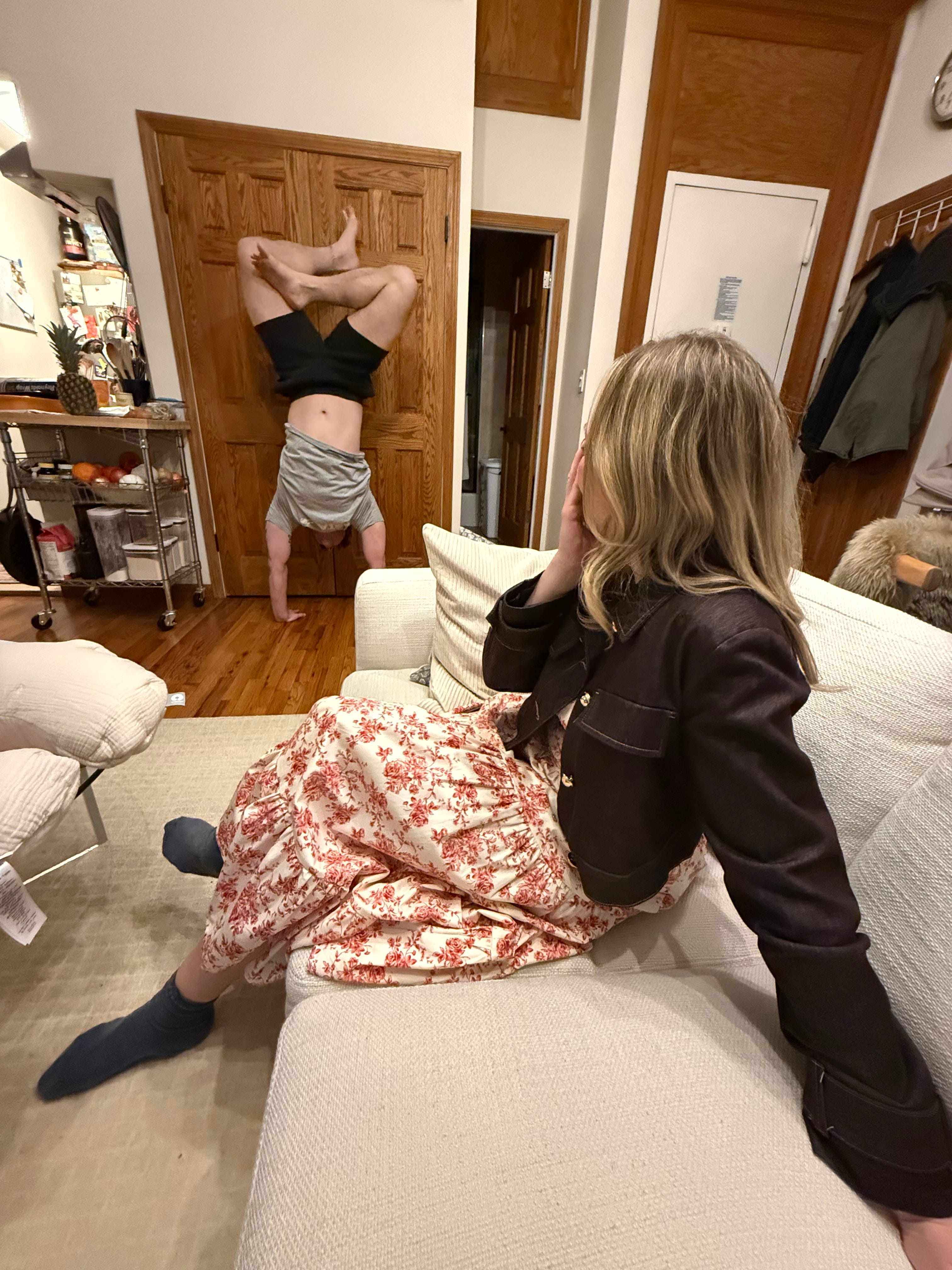
To go back to musical examples, there is the obvious tension and release I talked about before, but there are also the more subtle moments when a musician is doing something technical that is impressive to musicians, but is otherwise ignored by more casual listeners. In that musical moment, the artist is effortlessly playing something that would take a less-trained musician a lot of time to learn, and it’s possible that it’s even being improvised live. To me, playing something somewhat technically challenging off the cuff is more impressive than playing some extremely technical piece from rote memorization.
So, I was wrong all of those years ago to derail the rehearsal to present my then-theory of tension and release, because now I recognize that there are valid transitions between tension and release everywhere. Even when the obvious transition isn’t there, the lack of tension that makes something feel so fluid is the appreciable part. The lack of tension is predicated on the time spent getting out of that tension previously. Flow state then feels like a kind of meta-release, a sensation after all of the tension has been controlled for in advance.
Off topic, but a lot of metal-adjacent genres circa 2012 confused heaviness (which was the band’s goal at the time, not my own) with just playing low pitches. Most of our songs were in B♭, because we played in a tuning where our lowest strings were tuned to B♭. Not immune to the machismo that is high school aged guitar playing, I used a 7 string guitar where I actually had to tune the 6 normal strings to higher pitches than a standard guitar to facilitate the ‘drop’ B♭ lowest string. Playing in ‘Drop A’ would have been a half-step heavier per the genres failed logic and eliminated my need to tune up most of guitar, but saying you play in ‘Drop B♭’ versus ‘Drop A’ sounds more badass to any non-musical 17 year old.
This book will make its way into several of my next essays, because it covers a lot of ground and I liked it enough to get through it while on paternity leave.